
Professor Adrian D. Manning


Experimental ecosystem ecology | Ecological long-termism | Coexistence conservation
Professor Adrian Manning is an experimental ecosystem ecologist at the Fenner School of Environment and Society, the Australian National University, and Principal Investigator of the Coexistence Conservation Lab. His research focuses on how functioning ecosystems can be rebuilt after species, interactions and ecological processes have been lost. Ecosystem recovery is part of the research, and research is part of ecosystem recovery.
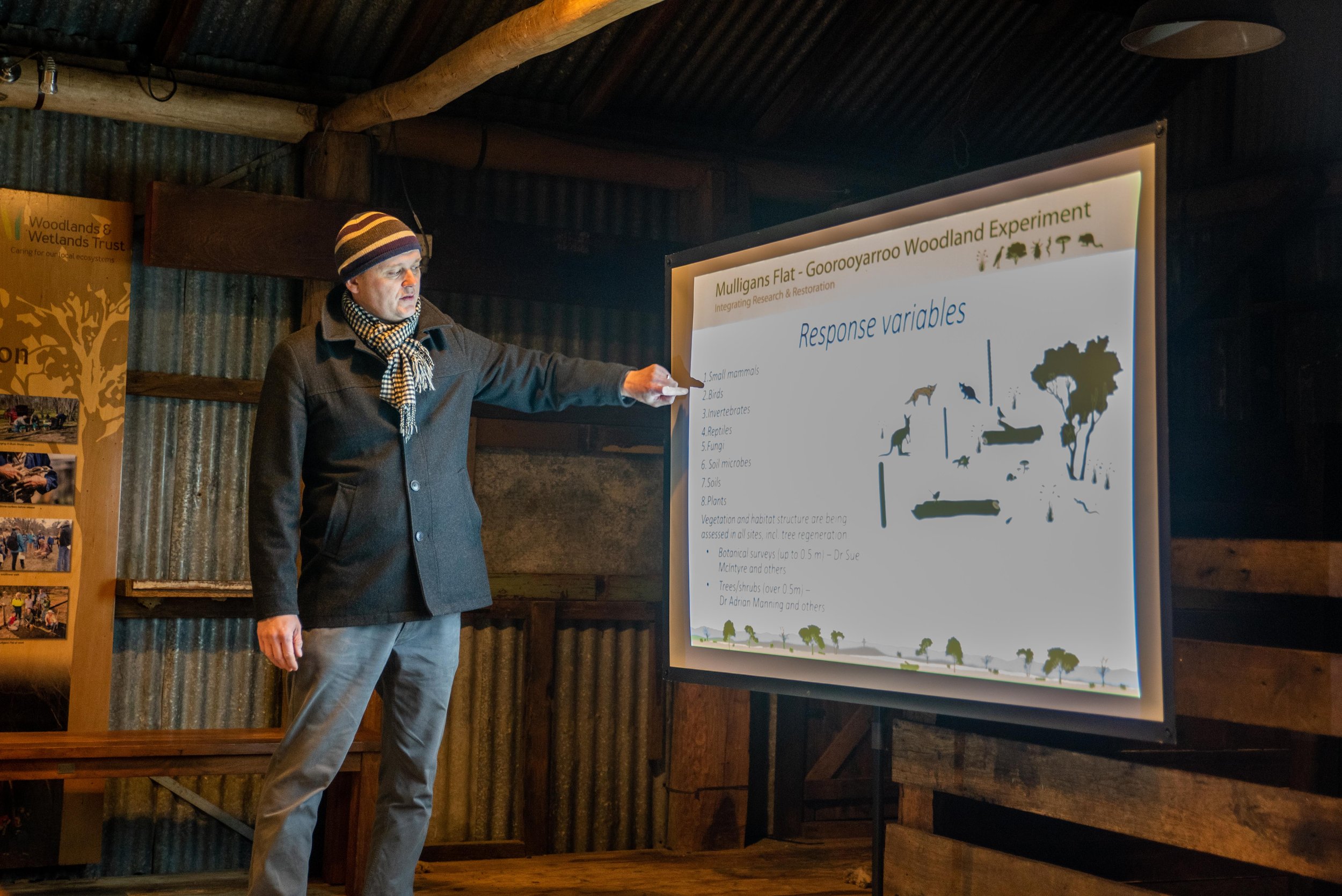
His work is grounded in ecological long-termism; designing research around the timescales on which ecosystems actually recover. For more than two decades he has led the Mulligans Flat–Goorooyarroo Woodland Experiment, where four locally extinct species have been returned to the ACT and whole-ecosystem change is followed from soils and fungi through plants, populations and species interactions.
Adrian works directly with the institutions that shape these landscapes. He is a Trustee of the Woodlands and Wetlands Trust, sits on national recovery teams for the superb parrot, eastern quoll and Pookila, and has briefed federal and ACT ministers, the Commonwealth Threatened Species Commissioner, the NSW Chief Scientist and Engineer, and NSW National Parks and Wildlife Service. Findings by Adrian and his group have changed how agencies undertake landscape and ecosystem management far beyond the Mulligans Flat – Goorooyarroo study site.
From this long-term experimental work emerged coexistence conservation focussed on finding ways for native species populations to rebuild, adapt and persist alongside introduced predators rather than depending indefinitely on exclusion. This concept now shapes much of the Lab’s work, from fox-impact mitigation and the reintroduction of the golden sun moth, to bush stone-curlews on Phillip Island, to a feasibility study for returning wildcats to Kielder Forest in England.
Adrian’s research spans restoration ecology, rewilding, translocation science, landscape ecology and conservation biology, with concepts emerging from sustained engagement with real ecological systems. He has also built the human systems around them; long-term partnerships across government, universities, NGOs and community, and a generation of researchers trained inside working ecosystem experiments.
His 2026 Cambridge University Press book, Rebuilding an Ecosystem, brings together twenty years of this approach.
Connect:


Publications
-
Rapley et al. (2026) Do survival predictors change over time? Investigating temporal dynamics in founder screening for reintroduction. Animal Behaviour, 235(123553).
Rapley et al. (2026) Novel application of a conservation detection dog to recover wildlife telemetry equipment. Animal Biotelemetry, 14(9).
Neaves et al. (2026) Evolutionary consequences of conservation havens and fenced sanctuaries. Conservation Biology, 40(e70175).
Brockett et al. (2026) Factors Affecting Multiple Paternity: Insights From the Eastern Quoll (Dasyurus viverrinus). Ecology and Evolution, 16(e73515).
Neaves et al. (2026) Navigating transformations from degraded to functional ecosystems. Trends in Ecology and Evolution.
-
Gould et al. (2025) Movement behaviour of migratory Latham’s Snipe Gallinago hardwickii during their non-breeding season in Australia. Bird Conservation International, 35(e34).
Shippley et al. (2025) Trophic rewilding: The diet of an opportunistic mesopredator. Biological Conservation, 302(111004).
Pan et al. (2025) Two-way gateway designs to allow free movement between safe havens for bettongs: A captive trial. Ecology and Evolution, 15(e71481).
Silver et al. (2025) A reference genome for the eastern bettong (Bettongia gaimardi). F1000Research, 13(1544).
-
Smith KJ, Pierson JC, Evans MJ, Gordon IJ & Manning AD(2024) Continental-scale identification and prioritisation of potential refugee species; a case study for rodents in Australia. Ecography, e07035.
Wilson BA, Evans MJ, Gordon IJ & Manning AD (2024b) The Translocation Continuum Framework for context-specific decision making. Frontiers in Ecology and the Environment, e2784.
Wilson BA, Evans MJ, Rapley S, Gordon IJ, Wimpenny C, Newport J & Manning AD (2024a) Everybody needs good neighbours: movement, habitat use, and conspecific association in a reintroduced mesopredator. Biodiversity and Conservation, 2024.
Gould LA, Manning AD, McGinness HM & Hansen BD (2024) A review of electronic devices for tracking small and medium migratory shorebirds. Animal Biotelemetry, 12(11).
Shokirov S, Jucker T, Levick S R, Manning A D & Youngentob K N (2024) Using multiplatform LiDAR to identify relationships between vegetation structure and the abundance and diversity of woodland reptiles and amphibians. Remote Sensing in Ecology and Conservation, 2024.
-
Read JL, Bradley K, Gordon IJ, Manning AD, Neaves LE, Reside AE, Smith KJ, Southgate R, Wayne AF, Weeks AR & Wilson BA (2023) Havens are a pathway, not an endpoint, for species recovery: A response to Woinarski et al. (2023). Biological Conservation, 285: 110212.
Andrewartha T, Evans MJ, Blencowe A, Brewer K, Gordon IJ & Manning AD (2023) Landscapes of nausea: Successful conditioned taste aversion in a wild red fox population. Conservation Science and Practice, 5(8): e12984.
Evans, MJ, Pierson, JC, Neaves, LE, Gordon, IJ, Ross, CE, Brockett, B, Rapley, S, Wilson, BA, Smith, KJ, Andrewartha, T, Humphries, N & Manning, AD (2023) Trends in animal translocation research. Ecography, 2023(3): e06528.
Cobden, M, Stojanovic, D, Rayner, L, Heinsohn, R & Manning, AD (2023) High nest survival, but variable reproductive output in the Superb Parrot (Polytelis swainsonii). Emu -Austral Ornithology, 123(1): 4–23.
Smith, KJ, Evans, MJ, Gordon, IJ, Pierson, JC, Newport, J & Manning, AD (2023) Analyzing captive breeding outcomes to inform reintroduction practice: lessons from the pookila (Pseudomys novaehollandiae). Journal of Mammalogy, 104(5): 1047–1061.
Smith, KJ, Evans, MJ, Gordon, IJ, Pierson, JC, McIntyre, S & Manning, AD (2023). Countering ecological misconceptions with strategic translocation and assessment of microhabitat use. Biological Conservation, 284: 110143.
Stojanovic, D, McLennan, E, Olah, G, Cobden, M, Heinsohn, R, Manning, AD, Alves, F, Hogg, C & Rayner, L (2023) Reproductive skew in a Vulnerable bird favors breeders that monopolize nest cavities. Animal Conservation, 23(5): 675 –683.
Wilson, BA, Evans, MJ, Gordon, IJ, Pierson, JC, Brockett, BM, Wimpenny, C, Batson, WG, Newport, J & Manning, AD (2023) Roadmap to recovery revealed through the reintroduction of an IUCN Red List species. Biodiversity and Conservation, 32(1): 227-248.
Shokirov, S, Jucker, T, Levick, SR, Manning, AD, Bonnet, T, Yebra, M & Youngentob, KN (2023) Habitat highs and lows: Using terrestrial and UAV LiDAR for modelling avian species richness and abundance in a restored woodland. Remote Sensing of Environment, 285: 113326.
-
Brockett B, Banks S, Neaves L, Gordon IJ, Pierson J & Manning AD (2022) Establishment, persistence and the importance of longitudinal monitoring in multi‐source reintroductions. Animal Conservation, 25(4): 550–565.
Evans MJ, Gordon IJ, Pierson JC, Neaves, LE, Wilson BA, Brockett B, Ross CE, Smith KJ, Rapley S, Andrewartha T, Humphries N & Manning AD (2022) Reintroduction biology and the IUCN Red List: the dominance of species of Least Concern in the peer-reviewed literature. Global Ecology and Conservation, 38: e02242.
Itoigawa, A, Hayakawa, T, Zhou, Y, Manning, AD, Zhang, G, Grutzner, F & Imai, H (2022) Functional diversity and evolution of bitter taste receptors in egg-laying mammals. Molecular Biology and Evolution, 39(6): msac107.
Smith, KJ, Evans, MJ, Gordon, IJ, Pierson, JC, Stratford, S & Manning, AD (2023) Mini Safe Havens for population recovery and reintroductions ‘beyond-the-fence’. Biodiversity and Conservation, 32(1): 203–225.
Wilson, B, Evans, ME, Gordon, IJ, Banks, SC, Batson, WG, Wimpenny, C, Newport, J & Manning, AD (2022) Personality and plasticity predict postrelease performance in a reintroduced mesopredator. Animal Behaviour , 187: 177–189.
-
Manning AD, Andrewartha TA, Blencowe A, Brewer K, Gordon IJ & Evans MJ (2021) Bettering the devil you know: Can we drive predator adaptation to restore native fauna? Conservation Science and Practice, 3(8): e447.
Evans MJ, Batson WG, Gordon IJ, Belton E, Chaseling T, Fletcher D, Harrison M, McElroy T, Mungoven A, Newport J, Pierson J, Portas T, Swain S, Wimpenny C & Manning AD (2021) The ‘Goldilocks Zone’ of predation: the level of fox control needed to select predator resistance in a reintroduced mammal in Australia. Biodiversity and Conservation, 30: 1731–1752.
Wilson BA, Evans MJ, Batson WG, Banks SC, Gordon IJ, Fletcher DB, Wimpenny C, Newport J, Belton E, Rypalski A, Portas T & Manning AD (2021) Reintroduction of the eastern quoll to Mulligans Flat Woodland Sanctuary, Australia, using trials, tactics, and adaptive management. In book:Soorae (2021) Global conservation translocation perspectives 2021: Case studies from around the globe (pp 194–199). IUCN SSC Conservation Translocation Specialist Group, Environment Agency, and Calgary Zoo.
Gordon IJ, Manning AD, Navarro L & Rouet-Leduc J (2021) Domestic livestock and rewilding: are they mutually exclusive?. Frontiers in Sustainable Food Systems, 5:68.
Gordon IJ, Pérez-Barbería FJ & Manning AD (2021) Rewilding Lite: Using Traditional Domestic Livestock to Achieve Rewilding Outcomes. Sustainability, 13(6): 3347.
-
Abicair, K, Manning, AD, Ford, F, Newport, J & Banks, S (2020) Habitat selection and genetic diversity of a reintroduced ‘refugee species’. Animal Conservation 23(3): 330–341.
Manning, AD, Cunningham, RB, Tongway, D, Lindenmayer & DB (2020) Woodlands and woody debris: Understanding structure and composition to inform restoration. PLoS One, 15(3): e0224258.
Ross, CE, McIntyre, S, Barton, PS, Evans, MJ, Cunningham, SA & Manning, AD (2020) A reintroduced ecosystem engineer provides a germination niche for native plant species, Biodiversity and Conservation, 29(3): 817-837.
Portas, TJ, Evans, MJ, Spratt, D, Vaz, PK, Devlin, JM, Barbosa, AD, Wilson, BA, Rypalski, A, Wimpenny, C, Fletcher, D, Gordon, IJ, Newport, J & Manning, AD (2020) Baseline health and disease assessment of founder eastern quolls (Dasyurus viverrinus) during a conservation translocation to mainland Australia. Journal of Wildlife Diseases, 56(3): 547-559.
Wilson, BA, Evans, MJ, Batson, WG, Banks, SC, Gordon, IJ, Fletcher, DB, Wimpenny, C, Newport, J, Belton, E, Rypalski, A, Portas, T & Manning, AD (2020) Adapting reintroduction tactics in successive trials increases the likelihood of establishment for an endangered carnivore in a fenced sanctuary. PLoS One, 15(6): e0234455.
-
Evans, MJ, Newport JS & Manning, AD (2019) A long-term experiment reveals strategies for the ecological restoration of reptiles in scattered tree landscapes. Biodiversity and Conservation, 28(11): 2825–2843.
Evans, MJ, Cunningham, SA, Gibb, H, Manning, AD & Barton, PS (2019) Beetle ecological indicators – A comparison of cost vs reward to understand functional changes in response to restoration actions. Ecological Indicators, 104: 209–218.
Manning, AD, Evans, MJ, Banks, SC, Batson, WG, Belton, E, Crisp, HA, Fletcher, DB, Gordon, IJ, Grarock, K, Munro, N, Newport, J, Pierson, J, Portas, TJ, Snape, MA & Wimpenny, C (2019) Transition to density dependence in a reintroduced ecosystem engineer, Biodiversity and Conservation, 28: 3803–3830.
Munro, NT, McIntyre, S, Macdonald, B, Cunningham, SA, Gordon, IJ, Cunningham, RB & Manning, AD (2019) Returning a lost process by reintroducing a locally extinct digging marsupial. PeerJ, 7: e6622.
Ringma, J, Legge, S, Woinarski, JCZ, Radford, JQ, Wintle, B, Bentley, J, Burbidge, AA, Copley, P, Dexter, N, Dickman, CR, Gillespie, GR, Hill, B, Johnson, CN, Kanowski, J, Letnic, M, Manning, AD, Menkhorst, P, Mitchell, N, Morris, K, Moseby, K, Page, M, Palmer, R & Bode, M (2019) Systematic planning can rapidly close the protection gap in Australian mammal havens. Conservation Letters, 12(1): e12611
Ross, CE, Munro, NT, Barton, PS, Evans, MJ, Gillen, J, Macdonald, BCT, McIntyre, S, Cunningham, SA & Manning, AD (2019) Effects of digging by a native and introduced ecosystem engineer on soil physical and chemical properties in temperate grassy woodland. PeerJ, 7: e7506.
-
Legge, S, Woinarski, JCZ, Burbidge, AA, Palmer, R, Ringma, J, Radford, JQ, Mitchell, N, Bode, M, Wintle, B, Baseler, M, Bentley, J, Copley, P, Dexter, N, Dickman, CR, Gillespie, GR, Hill, B, Johnson, CN, Latch, P, Letnic, M, Manning, AD, McCreless, EE, Menkhorst, P, Morris, Moseby, K, Page, M, Pannell, D & Tuft, K (2018) Havens for threatened Australian mammals: the contributions of fenced areas and offshore islands to the protection of mammal species susceptible to introduced predators. Wildlife Research, 45(7): 627–644.
Le Roux, DS, Ikin, K, Lindenmayer, DB, Manning, AD & Gibbons, P (2018) ‘The value of scattered trees for wildlife: Contrasting effects of landscape context and tree size’, Diversity and Distributions, 24(1): 69–81.
Radford, JQ, Woinarski, JCZ, Legge, S, Baseler, M, Bentley, J, Burbidge, AA, Bode, M, Copley, P, Dexter, N, Dickman, CR, Gillespie, G, Hill, B, Johnson, CN, Kanowski, J, Latch, P, Letnic, M, Manning, AD, Menkhorst, P, Mitchell, N, Morris, K, Moseby, K, Page, M & Ringma, J (2018) Degrees of population-level susceptibility of Australian terrestrial non-volant mammal species to predation by the introduced red fox (Vulpes vulpes) and feral cat (Felis catus). Wildlife Research, 45(7): 645–657.
-
Hamonts, K, Bissett, A, Macdonald, BCT, Barton, PS, Manning, AD & Young, A (2017) Effects of ecological restoration on soil microbial diversity in a temperate grassy woodland. Applied Soil Ecology, 117-118: 117–128.
Batson, WG, Gordon, IJ, Fletcher, DB, Portas, TJ & Manning, AD (2017) The effect of pre-release captivity on the stress physiology of a reintroduced population of wild eastern bettongs. Journal of Zoology, 303(4): 311–319.
Ross, CE, Barton, PS, McIntyre, S, Cunningham, SA & Manning, AD (2017) Fine-scale drivers of beetle diversity are affected by vegetation context and agricultural history. Austral Ecology, 42(7): 831–843.
McIntyre, S, Nicholls, A & Manning, AD (2017) Trajectories of floristic change in grassland: Landscape, land use legacy and seasonal conditions overshadow restoration actions. Applied Vegetation Science, 20(4): 582–593.
Barton, PS, Evans, MJ, Foster, CN, Cunningham, SA & Manning, AD (2017) Environmental and spatial drivers of spider diversity at contrasting microhabitats. Austral Ecology, 42(6): 700–710.
-
Barton, PS, McIntyre, S, Evans, MJ, Bump, JK, Cunningham, SA & Manning, AD (2016) Substantial long-term effects of carcass addition on soil and plants in a grassy eucalypt woodland. Ecosphere, 7(10): e01537.
Portas, TJ, Cunningham, RB, Spratt, D, Devlin, J, Holz, P, Batson, W, Owens, J & Manning, AD (2016) Beyond morbidity and mortality in reintroduction programmes: Changing health parameters in reintroduced eastern bettongs Bettongia gaimardi, Oryx, 50(4): 674–683.
Batson, WG, Gordon, IJ, Fletcher, DB & Manning, AD (2016) The effect of pre-release captivity on post-release performance in reintroduced eastern bettongs Bettongia gaimardi, Oryx, 50(4): 664–673.
Howland, BWA, Stojanovic, D, Gordon, IJ, Radford, J, Manning, AD & Lindenmayer, DB (2016) Birds of a feather flock together: Using trait-groups to understand the effect of macropod grazing on birds in grassy habitats, Biological Conservation, 94: 89–99.
Le Roux, DS, Ikin, K, Lindenmayer, DB, Bistricer, G, Manning, AD & Gibbons, P (2016) Effects of entrance size, tree size and landscape context on nest box occupancy: Considerations for management and biodiversity offsets. Forest Ecology and Management, 366: 135–142.
-
Batson, WG, Gordon, IJ, Fletcher, DB & Manning, AD (2015) Translocation tactics: a framework to support the IUCN Guidelines for wildlife translocations and improve the quality of applied methods. Journal of Applied Ecology, 52(6): 1598–1607.
Macdonald, BCT, Gillen, J, Tuomi, S, Newport, J, Barton, PS, Manning, AD (2015) Can coarse woody debris be used for carbon storage in open grazed woodlands? Journal of Environmental Quality, 44(4): 1210–1215.
McIntyre, S, Cunningham, RB, Donnelly, CF & Manning, AD (2015) Restoration of eucalypt grassy woodland: effects of experimental interventions on ground-layer vegetation. Australian Journal of Botany, 62(7): 570–579.
Rayner, L, Ikin, K, Evans, MJ, Gibbons, P, Lindenmayer, D, Manning, AD (2015) Avifauna and urban encroachment in time and space. Diversity & Distributions, 21(4): 428–440.
-
Barton, PS, Weaver, HJ & Manning, AD (2014) Contrasting diversity dynamics of phoretic mites and beetles associated with vertebrate carrion. Experimental and Applied Acarology, 63: 1–13.
Howland, B, Stojanovic, D, Gordon, IJ, Manning, AD, Fletcher, D & Lindenmayer, DB (2014) Eaten Out of House and Home: Impacts of Grazing on Ground-Dwelling Reptiles in Australian Grasslands and Grassy Woodlands. PLoS One, 9(12): e105966.
Ikin, K, Barton, PS, Knight, E, Lindenmayer, DB, Fischer, J, Manning, AD (2014) Bird community responses to the edge between suburbs and reserves. Oecologia, 174(2): 545–557.
Le Roux, DS, Ikin, K, Lindenmayer, DB, Blanchard, W, Manning, AD & Gibbons, P (2014) Reduced availability of habitat structures in urban landscapes: Implications for policy and practice. Landscape and Urban Planning, 125: 57–64.
Le Roux, DS, Ikin, K, Lindenmayer, DB, Manning, AD & Gibbons, P (2014) The future of large old trees in urban landscapes. PLoS One, 9(6): e99403.
Lindenmayer, DB, Laurance, WF, Franklin, JF, Likens, GE, Banks, SC, Blanchard, W, Gibbons, P, Ikin, K, Blair, D, Mcburney, L, Manning, AD & Stein, JAR (2014) New policies for old trees: Averting a global crisis in a keystone ecological structure. Conservation Letters, 7(1): 61–69.
Macdonald, BCT, Farrell, M, Tuomi, S, Barton, PS, Cunningham, SA, Manning, AD (2014) Carrion decomposition causes large and lasting effects on soil amino acid and peptide flux. Soil Biology and Biochemistry, 69: 132–140.
Manning, AD, Coles, BJ, Lunn, AG, Halley, DJ, Ashmole, P, Fallon, SJ (2014) New evidence of late survival of beaver in Britain. The Holocene, 24(12): 1849–1855.
Newport, J, Shorthouse, DJ, Manning, AD (2014) The effects of light and noise from urban development on biodiversity: implications for protected areas in Australia. Ecological Management and Restoration, 15(3): 204–214.
Portas, T, Fletcher, D, Spratt, D, Reiss, A, Holz, P, Stalder, K, Devlin, J, Taylor, D, Dobroszczyk, D & Manning, AD (2014) Health evaluation of free-ranging eastern bettongs (Bettongia gaimardi) during translocation for reintroduction in Australia. Journal of Wildlife Diseases, 50(2): 210–223.
Rayner, L, Lindenmayer, DB, Gibbons, P & Manning, AD (2014) Evaluating empirical evidence for decline in temperate woodland birds: A nationally threatened assemblage of species. Biological Conservation, 171: 145–155.
Rayner, L, Lindenmayer, DB, Wood, JT, Gibbons, P, Manning, AD (2014) Are protected areas maintaining bird diversity?. Ecography, 37(1): 43–53.
-
Azhar, B, Lindenmayer, D, Wood, J, Fischer, J, Manning, AD, McElhinny, C, Zakaria, M (2013) The influence of agricultural system, stand structural complexity and landscape context on foraging birds in oil palm landscapes. Ibis, 155(2): 297–132.
Barton, P, Cunningham, S, Manning, AD, Gibb, H, Lindenmayer, DB & Didham, RK (2013) The spatial scaling of beta diversity. Global Ecology and Biogeography, 22(6): 639–647.
Barton, PS, Cunningham, SA, Lindenmayer, DB & Manning, AD (2013) The role of carrion in maintaining biodiversity and ecological processes in terrestrial ecosystems. Oecologia, 171: 761–772.
Barton, PS, Cunningham, SA, Macdonald, B, McIntyre, S, Lindenmayer, DB & Manning, AD (2013) Species traits predict biodiversity dynamics at ephemeral resource patches created by carrion, PLoS One, 8(1): e53961.
Bennett, V, Doerr, V, Doerr, E, Manning, AD, Lindenmayer, DB & Yoon, HJ (2013) Habitat selection and behaviour of a reintroduced passerine: linking experimental restoration, behaviour and habitat ecology. PLoS One, 8(1): e54539.
Bennett, V, Doerr, V, Doerr, E, Manning, AD, Lindenmayer, DB & Yoon, HJ (2013) Causes of reintroduction failure of the brown treecreeper: Implications for ecosystem restoration. Austral Ecology, 38(6): 1–13.
Lindenmayer, DB, Laurance, WF, Franklin, JF, Likens, GE, Banks, SC, Blanchard, W, Gibbons, P, Ikin, K, Blair, D, McBurney, L, Manning, AD & Stein, JAR (2013) New policies for old trees: averting a global crisis in a keystone ecological structure. Conservation Letters, 7(1): 61–69.
Ikin, K, Manning, AD, Knight, E, Fischer, J & Lindenmayer, DB (2013) Bird community responses to the edge between suburbs and reserves. Oecologia, 174: 545–557.
Ikin, K, Beaty, RM, Lindenmayer, D, Knight, E, Fischer, J & Manning, AD (2013) Pocket parks in a compact city: how do birds respond to increasing residential density?. Landscape Ecology, 28: 45–56.
Ikin, K, Knight, E, Lindenmayer, DB, Fischer, J & Manning, AD (2013) The influence of native versus exotic streetscape vegetation on the spatial distribution of birds in suburbs and reserves. Diversity and Distributions, 19(3): 294–306.
Manning, AD, Cunningham, RB & Lindenmayer, DB (2013) Bringing forward the benefits of coarse woody debris in ecosystem recovery under different levels of grazing and vegetation density, Biological Conservation, 157: 204–214.
-
Azhar, B, Lindenmayer, DB, Wood, J, Fischer, J, 2012, Manning, AD, McElhinny, C & Zakaria, M (2012) The contribution of illegal hunting, culling of pest species, road accidents and feral dogs to biodiversity loss in established oil palm landscapes. Wildlife Research, 40(1): 1–9.
Sheean, VA, Manning, AD & Lindenmayer, DB (2012) The anatomy of a failed reintroduction: A case study with the Brown Treecreeper. Emu, 112(4): 298–312.
Ikin, K, Knight, E, Lindenmayer, DB, Fischer, J & Manning, AD (2012) The influence of native versus exotic streetscape vegetation on the spatial distribution of birds in suburbs and reserves. Diversity and Distributions, 19(3): 294–306.
Ikin, K, Knight, E, Lindenmayer, DB, Fischer, J & Manning, AD (2012) Linking bird species traits to vegetation characteristics in a future urban development zone: implications for urban planning. Urban Ecosystems, 15: 961–977.
Manning, AD, Gibbons, P, Fischer, J, Oliver, D, Lindenmayer, DB (2012) Hollow futures? Tree decline, lag effects and hollow-dependent species. Animal Conservation, 16(4): 395–403.
Shorthouse, DJ, Iglesias, D, Jeffress, S, Lane, S, Mills, P, Woodbridge, G, McIntyre, S, Manning, AD (2012) The ‘making of’ the Mulligans Flat – Goorooyarroo experimental restoration project. Ecological Management Restoration, 13(2): 112–125.
Stagoll, K, Knight, E, Lindenmayer, DB, Fischer, J & Manning, AD (2012) Large trees are keystone structures in urban parks. Conservation Letters, 5(2): 115–122.
-
Sheean, VA, Manning, AD, & Lindenmayer, DB (2011) An assessment of scientific approaches towards species relocations in Australia. Austral Ecology, 37(2): 204–215.
Barton, PS, Manning, AD, Gibb, H, Wood, JT, Lindenmayer, DB & Cunningham, SA (2011) Experimental reduction of native vertebrate grazing and addition of logs affects beetle diversity at multiple scales. Journal of Applied Ecology, 48(4): 943–951.
Manning, AD, Wood, J, Cunningham, RB, McIntyre, S, Shorthouse, DJ, Gordon, IJ & Lindenmayer, DB (2011) Integrating research and restoration: A long-term experiment in south-eastern Australia. Australian Zoologist, 35(3): 633–648.
Barton, PS, Gibb, H, Manning, AD, Lindenmayer, DB & Cunningham, SA (2011) Morphological traits as predictors of diet and microhabitat use in a diverse beetle assemblage. Biological Journal of the Linnean Society, 102(2): 301–310.
-
Manning, AD, Kesteven, J, Stein, J, Lunn, A, Xu, TB & Rayner, B (2010) Could native Scots pines (Pinus sylvestris) still persist in northern England and southern Scotland? Plant Ecology & Diversity, 3(2): 187–201.
Barton, PS, Manning, AD, Gibb, H, Lindenmayer, DB, Cunningham, SA (2010) Fine-scale heterogeneity in beetle assemblages under co-occurring Eucalyptus in the same subgenus. Journal of Biogeography, 37(10): 1927–1937.
McIntyre, S, Stol, J, Harvey, A, Nicholls, M, Campbell, A, Reid, A, Manning, AD & Lindenmayer, DB (2010) Biomass and floristic patterns in the ground layer vegetation of box-gum grassy eucalypt woodland in Goorooyarroo and Mulligans Flat Nature Reserves, Australian Capital Territory. Cunninghamia, 11(3): 319–357.
Stagoll, K, Manning, AD, Knight, E, Fischer, J & Lindenmayer, DB (2010) Using bird-habitat relationships to inform urban planning. Landscape and Urban Planning, 98(1): 13–25.
Manning, AD & Fischer, J (2010) Mind the gap: future depends on sciences and humanities. Nature, 463: 425.
-
Manning, AD & Lindenmayer, DB (2009) Paddock trees, parrots and agricultural production: an urgent need for large-scale, long-term restoration in south-eastern Australia. Ecological Management and Restoration, 10(2): 126–135.
Manning, AD, Gibbons, P & Lindenmayer, DB (2009) Scattered trees: a complementary strategy for facilitating adaptive responses to climate change in modified landscapes? Journal of Applied Ecology, 46(4): 915–919.
Manning, AD, Gordon, IJ, Ripple, WJ (2009) Restoring landscapes of fear with wolves in the Scottish Highlands. Biological Conservation, 142(10): 2314–2321.
Manning, AD, Fischer, J, Felton, A, Newell, B, Steffen, W & Lindenmayer, DB (2009) Landscape fluidity – a unifying perspective for understanding and adapting to global change. Journal of Biogeography, 35(2): 193–199.
Barton, PS, Manning, AD, Gibb, H, Lindenmayer, DB & Cunningham, SA (2009) Conserving ground-dwelling beetles in an endangered woodland community: Multi-scale habitat effects on assemblage diversity. Biological Conservation, 142(8): 1701–1709.
Fischer, J, Brosi, B, Daily, GC, Ehrlich, PR, Goldman, R, Goldstein, J, Lindenmayer, DB, Manning, AD, Mooney, HA, Pejchar, L, Ranganathan, J & Tallis, H (2009) Fostering constructive debate: a reply to Chappell et al. Frontiers in Ecology and the Environment, 7(4): 184.
Lindenmayer, DB, Fischer, J, Felton, A, Crane, M, Michael, D, Macgregor, C, Montague-Drake, R, Manning, AD & Hobbs, RJ (2009) Novel ecosystems resulting from landscape transformation create dilemmas for modern conservation practice. Conservation Letters, 1(3): 129–135.
-
Gibbons, P, Lindenmayer, DB, Fischer, J, Manning, AD, Weinberg, A, Seddon, J, Ryan, P & Barrett, G (2008) The future of scattered trees in agricultural landscapes. Conservation Biology, 22(5): 1309– 1319.
Lindenmayer, DB, Cunningham, RB, MacGregor, C, Crane, M, Michael, D, Fischer, J, Montague-Drake, R, Felton, A, Manning, AD (2008) Temporal changes in vertebrates during landscape transformation: a large-scale "natural experiment". Ecological Monographs, 78(4): 567–590.
Lindenmayer, D, Hobbs, RJ, Montague-Drake, R, Alexandra, J, Bennett, A, Burgman, M, Cale, P, Calhoun, A, Cramer, V, Cullen, P, Driscoll, D, Fahrig, L, Fischer, J, Franklin, J, Haila, Y, Hunter, M, Gibbons, P, Lake, S, Luck, G, MacGregor, C, McIntyre, S, Mac Nally, R, Manning, AD, Miller, J, Mooney, H, Noss, R, Possingham, H, Saunders, D, Schmiegelow, F, Scott, M, Simberloff, D, Sisk, T, Tabor, G, Walker, B, Wiens, J, Woinarski, J & Zavaleta, E (2008) A checklist for ecological management of landscapes for conservation. Ecology Letters, 11(1): 78–91.
Fischer, J, Brosi, B, Daily, GC, Ehrlich, PR, Goldman, R, Goldstein, J, Lindenmayer, DB, Manning, AD, Mooney, HA, Pejchar, L, Ranganathan, J & Tallis, H (2008) Should agricultural policies encourage land sparing or wildlife-friendly farming? Frontiers in Ecology and the Environment, 6(7): 380–385.
-
Manning, AD, Lindenmayer, DB & Cunningham, RB (2007) A study of coarse woody debris volumes in two box-gum grassy woodland reserves in the Australian Capital Territory. Ecological Restoration and Management, 8(3): 221–224.
Fischer, J, Manning, AD, Steffen, W, Rose, DB, Daniell, K, Felton, A, Garnett, S, Gilna, B, Heinsohn, R, Lindenmayer, DB, MacDonald, B, Mills, F, Newell, B, Reid, J, Robin, L, Sherren, K & Wade, A (2007) Mind the sustainability gap. Trends in Ecology and Evolution, 22(12): 621–624.
Lindenmayer, DB, Fischer, J, Felton, A, Montague-Drake, R, Manning, AD, Simberloff, D, Youngentob, K, Saunders, D, Wilson, D, Felton, AM, Blackmore, C, Lowe, A, Bond, S, Munro, N & Elliott, CP (2007) The complementarity of single-species and ecosystem-oriented research in conservation research. OIKOS, 116(7): 1220–1226.
Manning, AD, Lindenmayer, DB, Barry, SC & Nix, HA (2007) Large-scale spatial and temporal dynamics of the vulnerable and highly mobile Superb Parrot. Journal of Biogeography, 34(2): 289–304.
-
Manning, AD, Lindenmayer, DB, & Fischer, J (2006) Stretch goals and backcasting: approaches for overcoming barriers to large-scale ecological restoration. Restoration Ecology, 14(4): 487–492.
Manning, AD, Lindenmayer, DB, Barry, SC & Nix, HA (2006) Multi-scale site and landscape effects on the vulnerable superb parrot of south-eastern Australia during the breeding season. Landscape Ecology, 21(7): 1119–1133.
Manning, AD, Fischer, J & Lindenmayer, DB (2006) Scattered trees are keystone structures - implications for conservation. Biological Conservation, 132(3): 311–321.
Fischer, J, Lindenmayer, DB, Manning AD (2006) Biodiversity, ecosystem function, and resilience: Ten guiding principles for commodity production landscapes. Frontiers in Ecology and the Environment, 2(4): 80–86.
Manning, AD, Lindenmayer, DB, Barry, SC & Nix, HA (2005) A bioclimatic analysis for the highly mobile superb parrot of south-eastern, mainland Australia. The Emu, 105(3): 193–201.
Manning, AD, Lindenmayer, DB, Barry, SC (2004) The conservation implications of bird reproduction in the agricultural "matrix": a case study of the vulnerable superb parrot of southeastern Australia. Biological Conservation, 120(3): 363–374.
Manning, AD, Lindenmayer, DB & Nix, HA (2004) Continua and Umwelt: novel perspectives on viewing landscapes. OIKOS, 104(3): 621–628.
Lindenmayer, DB, Manning, AD, Smith, PL, Possingham, HP, Fischer, J, Oliver, I, MacCarthy, MA (2002) The focal-species approach and landscape restoration: a critique. Conservation Biology, 16(2): 338–345.
Manning, AD, Birley, R & Tipping, R (1997) Roman impact on the environment at Hadrian's Wall: precisely dated pollen analysis from Vindolanda, northern England. The Holocene, 7(2): 175–186.